Africa’s digital economy is growing at a remarkable speed, opening new opportunities for people, businesses, and governments across the continent.
Building strong cyber resilience will be key to sustaining that momentum, according to the new Mastercard-commissioned whitepaper, Africa’s Digital Defense Race.
The whitepaper highlights that between 2016 and 2025, mobile money users grew 5.9 times, digital banking users 4.7 times, and the e-commerce market 5.3 times.
The findings come as Africa’s digital payments economy is on track to reach USD 1.5 trillion by 2030.

However, cyber threat activity grew at a similar pace over the same period, highlighting both the growing risk facing Africa’s digital economy and the opportunity to strengthen the governance, skills, infrastructure, and collaboration needed to secure its continued growth.
Mastercard Cyber Insights recorded 69,236 observed cyber events targeting African organizations in 2025, equivalent to roughly one event every eight minutes.
Between 2016 and 2025, cyberattacks across the continent increased by more than 421%, compared with 307% globally, the whitepaper finds.
The whitepaper shows how cyber resilience priorities vary across Africa’s diverse digital ecosystem.
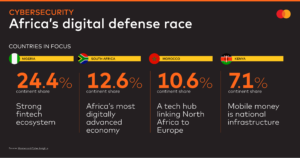
Nigeria, home to one of Africa’s largest fintech ecosystems, accounted for a significant share of observed cyberattacks in Africa this year.
South Africa’s concentrated financial sector was the target of 12.6% of the continent’s observed attacks.
Morocco, a growing regional technology hub linking North Africa to Europe, has built one of the continent’s more institutionalized cyber governance structures.